When you buy through links on our articles, Future and its syndication partners may earn a commission.

Russian state-owned Energia rocket company has secured a patent for a novel spacecraft architecture designed to generate artificial gravity, a capability which could provide a huge boost for long-duration crewed missions.
A report from Russian state media outlet TASS, which obtained the patent, states that the rotating system is designed to generate a gravitational force of 0.5g, or 50% of Earth’s gravity. The patent documentation includes illustrations of a notional space station structure with a central axial module with both static and rotating components, with modules and habitats connected by a hermetically sealed, flexible junction.
The radially attached habitable modules would be rotated around this axis to simulate gravity for the crew by producing an outward-pushing centrifugal force. These would need to rotate about five revolutions per minute, and have a radius of 131 feet (40 meters) in order to produce 0.5g. A space station of that size would require multiple launches with each module that would then be assembled in orbit.
The documentation notes the disadvantage of the need for spinning and coordinating the rotation of transport ships to dock with the station, which it notes reduces the safety of using such a station.
Generating artificial gravity could have profound impacts for crews on long-duration space missions, whether in low Earth orbit on interplanetary voyages into deep space. Exposure to microgravity has numerous impacts on astronauts, including muscle atrophy and bone density loss.

NASA has produced concepts such as the rotating wheel space station concept Nautilus-X, while, more recently, commercial firm Vast has said it will pursue artificial gravity stations.
Russia did not indicate timelines for such a project nor resources to back its development. The patent does however indicate interest in the concept of artificial gravity at a time when the end of the International Space Station (ISS) is approaching and new national and commercial station plans are moving forward.
Currently, NASA and Roscosmos plan to deorbit the ISS in 2030, using a modified SpaceX Dragon capsule to push the station down into a fiery death over the Pacific Ocean. Russia has committed to stay aboard the ISS until 2028.
LATEST POSTS
- 1
 More than 800 flights canceled as FAA cuts traffic at 40 major airports. Here's what to know.
 - 2IDF Home Front Command extends siren warning times for Hezbollah rockets in North
- 3They want better health care — so they're turning to crypto startups
- 4Disney's latest short film 'Versa' tackles a difficult subject: Pregnancy loss. It's resonating with viewers.
- 58 Espresso Bean Starting points All over the Planet





- Crypto Investor’s Family Tied Up and Beaten by Armed Gangs in Their Home
- A rare whale is having an encouraging season for births. Scientists warn it might still go extinct
- Understanding Preschool Projects: Cultivating Abilities and Advancement
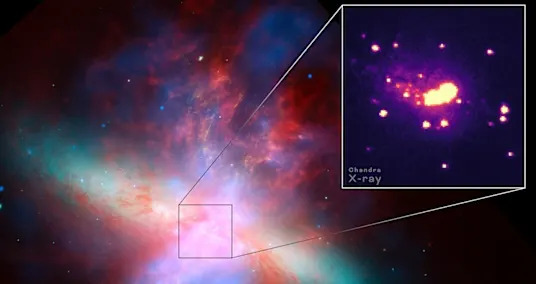
- This star-forming galaxy is blowing out powerful winds topping 2 million mph
- New materials, old physics – the science behind how your winter jacket keeps you warm
- Great DSLR Cameras for Photography Devotees
- Blood pressure drug recalled for possible cross-contamination
- The race to mine the moon is on – and it urgently needs some clear international rules
- Figure out How to Clean and Really focus on Your Lab Jewel